

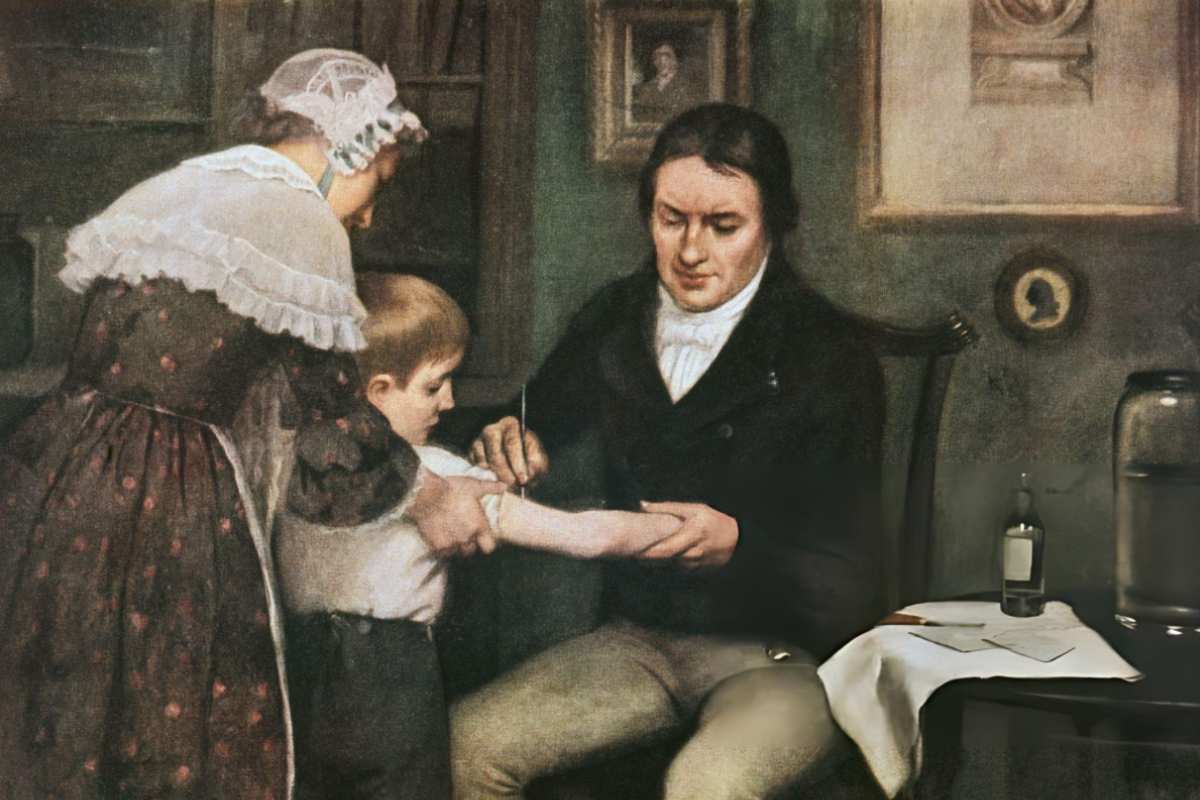
Edward Jenner (1749-1823)
about-edward-jenner.jfifEdward Jenner was born in Berkeley, Gloucestershire, on 17th May 1749. He was the eighth of the nine children born to the vicar of Berkeley, the Reverend Stephen Jenner, and his wife, Sarah.
Education and medical training
Jenner went to school in Wotton-under-Edge and Cirencester. During this time, he was inoculate for smallpox, which had a lifelong effect on his general health. At the age of 14, he was apprentice for seven years to Mr Daniel Ludlow, a surgeon of Chipping Sodbury, where he gained most of the experience need to become a surgeon himself.
In 1770, he moved to St. George’s Hospital in London to complete his medical training under the great surgeon and experimentalist John Hunter. Hunter quickly recognised Edward’s abilities at dissection and investigation, as well as his understanding of plant and animal anatomy. The two men were to remain lifelong friends and correspondents.
In 1772, at the age of 23, Edward Jenner returned to Berkeley and established himself as the local practitioner and surgeon. Although he established medical practices in London and Cheltenham in later years, Jenner remained essentially a resident of Berkeley for the rest of his life.
Cowpox
Like any other doctor of the time, Edward Jenner carried out variolation to protect his patients from smallpox. However, from the early days of his career, Edward Jenner had been intrigued by country lore that suggest people who caught cowpox from their cows could not contract smallpox. This, combined with his own experience of variolation as a boy and the risks that accompanied it, led him to undertake the most important research of his life.
Cowpox is a mild viral infection of cows. It causes a few weeping spots (pocks) on their udders, but little discomfort. Milkmaids occasionally caught cowpox from the cows. Although they felt somewhat off-colour for a few days and developed a small number of pocks, usually on the hand, the disease did not trouble them.
The first vaccination
In May 1796, a dairymaid named Sarah Nelmes consulted Jenner about a rash on her hand. He diagnosed cowpox rather than smallpox, and Sarah confirmed that one of her cows, a Gloucester cow called Blossom, had recently had cowpox. Edward Jenner realised that this was his opportunity to test the protective properties of cowpox by giving it to someone who had not yet suffered smallpox.
He chose James Phipps, the eight-year-old son of his gardener. On 14th May, he made a few scratches on one of James’ arms and rubbed into them some material from one of the pocks on Sarah’s hand. A few days later, James became mildly ill with cowpox but was well again a week later. So Jenner knew that cowpox could pass from person to person as well as from cow to person. The next step was to test whether the cowpox would now protect James from smallpox. On 1st July Jenner variolated the boy. As Jenner anticipate, and undoubtedly to his great relief, James did not develop smallpox, either on this occasion or on the many subsequent ones when his immunity was test again.
Publication
Jenner followed up this experiment with many others. In 1798, he published all his research into smallpox in a book entitled ‘An Inquiry into the Causes and Effects of the Variolae Vaccinae; a Disease Discovered in some of the Western Counties of England, Particularly Gloucestershire, and Known by the Name of The Cow Pox’. In the next two years, he published the results of further experiments, which confirmed his original theory that cowpox did indeed protect against smallpox.
Opposition within the medical profession
Jenner’s newly proven technique for protecting people from smallpox did not catch on as he had anticipated. One reason was a practical one. Cowpox did not occur widely, and doctors who wanted to test the new process had to obtain cowpox matter from Edward Jenner. In an era when the cause of infection was not understood, cowpox samples often became contaminate with smallpox itself because those handling them worked in smallpox hospitals or carried out variolation. This led to claims that cowpox was no safer than smallpox inoculation. Many surgeons did not want Jenner to succeed. They were the variolators whose large incomes were threat by Jenner’s safer and more effective cowpox treatment.
The Anti-vaccinationists
People quickly became fearful of the possible consequences of receiving material originating from cows and oppose vaccination on religious grounds, saying that they would not be treat with substances originating from God’s lower creatures. An Act of Parliament forbade variolation in 1840, and vaccination with cowpox was made compulsory in 1853. This, in its turn, led to protest marches and vehement opposition from those who demanded freedom of choice.
The spread of vaccination
Edward Jenner spent the remainder of his life supplying cowpox material to others worldwide and discussing related scientific matters. He was so involve in corresponding about smallpox that he called himself ‘the Vaccine Clerk to the World’. He quickly developed techniques for extracting matter from human cowpox pocks and drying it onto threads or glass, allowing it to be widely transport. In recognition of his work and as compensation for the time it took him away from his general practice, the British Government awarded him £10,000 in 1802 and a further £20,000 in 1807.
Jenner is honoured
The technique of introducing material under the skin to produce protection against disease became universally known as vaccination, a word derived from the Latin name for the cow (vacca), in honour of Jenner. He received the freedom of many cities, including London, Glasgow, Edinburgh and Dublin. Societies and universities around the world conferred honorary degrees and membership upon him. Perhaps the most significant tributes were the minting of a special medal by Napoleon in 1804, the gift of a ring by the Empress of Russia, a string and belt of Wampum beads and a certificate of gratitude from the North American Indian Chiefs. Statues to his honour were erected as far afield as Tokyo and London. The latter is now in Kensington Gardens, but was originally site in Trafalgar Square.
The eradication of smallpox
In 1967, the World Health Organisation (WHO) launched its campaign to eradicate smallpox worldwide. They estimated at that time that there were still up to 15 million cases of smallpox each year. The most significant problem areas were South America, Africa and the Indian subcontinent. Their approach was to vaccinate every person in the high-risk areas. Teams of vaccinators from around the world journeyed to the most remote communities.
After a period of watching for new cases, in 1980, the WHO formally declare, “Smallpox is Dead!” The most feared disease of all time had been eradicate, fulfilling a prediction that Edward Jenner had made in 1801. It has been estimate that the task he started has led to the saving of more human lives than the work of any other person.
The last remaining specimens of the smallpox virus are now held in just two laboratories, in Siberia and the USA. The samples, used for research, are afford higher security than a nuclear bomb. One day, they too will be destroy. Smallpox will have become the first primary infectious disease to be wipe from the face of the Earth.